
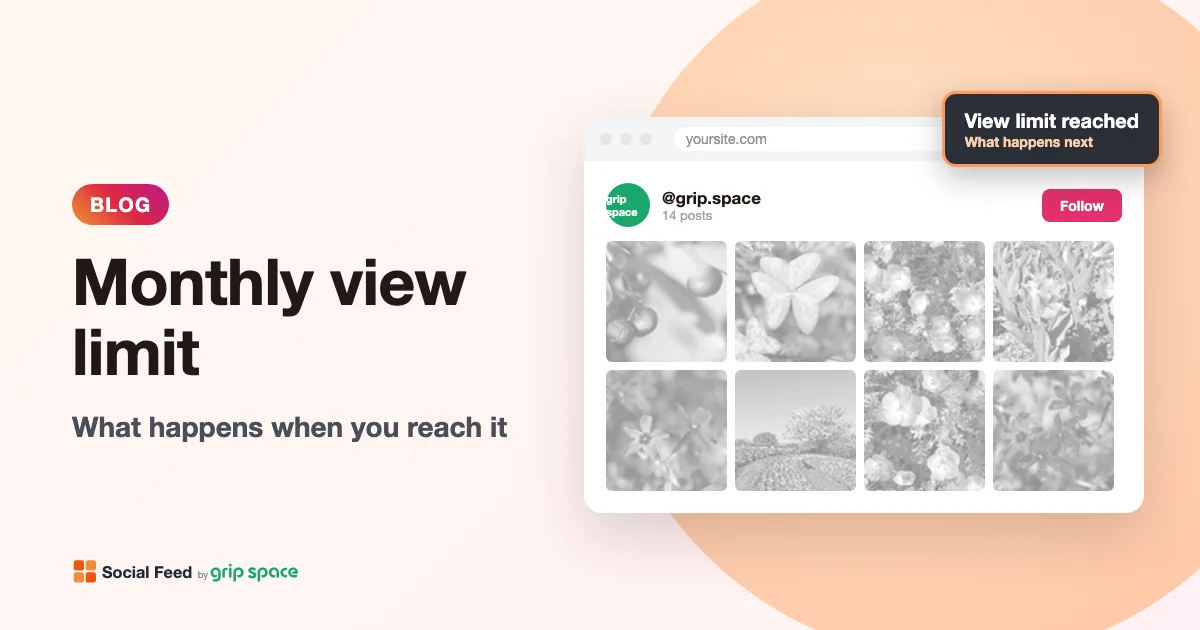
What happens when your Instagram widget reaches its monthly view limit
The Free and Light plans of Social Feed by grip space include a monthly view limit. Going over it does not switch your feed off on the spot, but it helps to know exactly when it would, what counts as a view, and what changing your plan does to the rule. This article walks through all of it, with timelines you can compare to your own numbers.
Updated October 12, 2026
The short answer
- Each plan has a number of widget views per month: 3,000 on Free, 30,000 on Light, and no limit on Standard. Views from all your widgets are added together.
- Going over the limit in one month changes nothing on your site. The feed keeps showing.
- Your feed pauses only if both of the previous two calendar months were over the limit. It then stays paused for the current month.
- While paused, the feed shows nothing on your pages, and views are still counted. If the paused month stays under the limit, the feed comes back on the 1st of the next month.
- Changing to a plan with a higher limit lifts the pause within about 10 minutes, without touching the code on your site.
If you are still deciding whether the Free plan is enough for you, our overview of what you get on the free plan covers all of its limits side by side. This article goes deeper into the view limit alone.
The limits by plan
| Free | Light | Standard | |
|---|---|---|---|
| Views per month (all widgets combined) | 3,000 | 30,000 | Unlimited |
| Widgets | 1 | Up to 3 | Unlimited |
| Price | $0 | $8 a month, or $80 a year | $24 a month, or $240 a year |
| Usage meter in the dashboard | Views, limit and percentage | Views, limit and percentage | Views, marked “(no limit)” |
Prices are in US dollars, and applicable tax is added at checkout. Current prices are always in the pricing section.
What counts as a view
A view is counted each time a widget is drawn on a live web page. In practice that means:
- One page load with the feed is one view. When a visitor opens a page that contains your embed code, the widget builds the feed and records one view.
- Every page load counts, including repeat visits. A visitor who opens five pages with the feed, or reloads the same page five times, adds five views. Views are not unique visitors.
- Each widget on a page counts separately. If one page shows two widgets, for example a slider near the top and a grid in the footer, one load of that page adds two views.
- All widgets on your account share the limit. The monthly total is the sum of every widget connected to your account.
- Views are counted per calendar month. The count starts again on the 1st of each month. There is no rolling 30-day window for the limit.
And here is what does not count:
- Visits identified as bots or crawlers. Requests from known bots and automated tools are filtered out before they are counted, because the count is used for the plan limit.
- The preview in your dashboard. Adjusting settings and watching the preview does not use views.
- Unpublished widgets. A widget switched to Unpublished draws nothing and counts nothing. Our article on hiding your feed temporarily explains the switch.
- Pages where the embed code is not present. Only pages that actually contain the script tag are involved, however busy the rest of your site is.
One thing that still counts, and surprises people: views during a paused month. The paused widget draws nothing, but it still records a view, so that the count reflects how much traffic your feed pages receive. That is what decides whether the feed comes back.
The exact rule for pausing
At any moment, the widget looks at the view totals of the two previous calendar months and compares them with your current plan’s limit:
| Last month | The month before | Your feed this month |
|---|---|---|
| Under or at the limit | Any | Showing |
| Over the limit | Under or at the limit | Showing |
| Over the limit | Over the limit | Paused for the whole month |
Three details are worth knowing:
- “Over” means more than the limit. Exactly 3,000 views on the Free plan is not over; 3,001 is.
- The current month never pauses your feed by itself. However many views you get this month, the feed keeps showing until the month ends. This month only matters for what happens next month.
- The comparison uses your plan’s limit today. Past months are not judged by the plan you had then, but by the limit of the plan you have now. This is why upgrading lifts a pause, and why downgrading deserves a quick check first (more on both below).
A month-by-month example
Here is how the rule plays out on the Free plan (3,000 views a month) for a site that gets busier over a few months, then quieter. The numbers are made up for illustration.
| Month | Views that month | Feed status | Why |
|---|---|---|---|
| March | 2,400 | Showing | Under the limit |
| April | 3,600 | Showing | Over the limit, but March was under |
| May | 2,900 | Showing | April was over, but March was under |
| June | 3,800 | Showing | May was under |
| July | 4,100 | Showing | June was over, May was under. July is a second month over, so the feed will pause in August |
| August | 2,600 (still counted) | Paused | June and July were both over |
| September | 2,800 | Showing | August was under, so the pair is broken |
Notice that April and June were both over the limit, but never in consecutive months, so nothing happened. The pause came only after June and July. And in August, the paused month, the views were still counted; because they stayed under 3,000, the feed came back on September 1.
If August had also gone over 3,000, September would stay paused too, because July and August would then be the two months in a row. A feed on a page whose traffic stays above the limit remains paused until traffic drops or the plan changes.
What visitors see while the feed is paused
Nothing at all where the feed would be. There is no error message, no empty frame, no placeholder and no “Powered by” line. The rest of your page loads and works as usual, and the space the feed would take simply is not there.
If you open your browser’s developer tools and look at the embed script’s response, you will see a short comment saying the monthly view limit was exceeded. That is a quick way to confirm that a missing feed is caused by the limit and not by something else, such as a website builder removing the code. Our checklist Instagram feed not showing on your website? covers the other causes.
Your settings, your embed code and your Instagram connection are not affected by a pause. When the feed comes back, it looks exactly as it did before.
Reading the usage meter in your dashboard
The dashboard shows a usage meter in two places: at the top of your widget list, and on the plan screen. It shows:
- Views this month, labeled with the month name, for example “Views in October”.
- Your limit and the percentage used, for example “/ 3,000 limit (64%)”. The percentage is rounded down.
- A progress bar that changes color at 80% and turns red at 100% or when the feed is paused. The bar stops at full even if you are over the limit; the percentage keeps counting past 100.
- A link to your plans on the meter above the widget list.
Below the bar, a short message tells you what happens next. These are the messages you can see, from least to most urgent:
| When | Message on the meter |
|---|---|
| 80% or more of the limit | “You have used 80% of this month’s limit. Your widgets will keep showing until the end of the month even if you exceed it.” (with your actual percentage) |
| Over the limit this month, last month under | “You exceeded this month’s limit. Your widgets will keep showing until the end of the month. If you exceed it again next month, they will stop showing the month after.” |
| Over the limit this month and last month | “You exceeded the limit again this month. Your widgets will stop showing on the 1st of next month. Change your plan this month to keep them showing.” |
| Paused this month | “Your views exceeded the limit for 2 months in a row, so your widgets are not shown on your site this month. Change your plan to show them again right away.” |
The third message is the one to act on: it is your last chance to keep the feed showing without a gap. On the Standard plan, the meter shows your views with “(no limit)” and no bar, because there is nothing to run out of.
Each widget’s card in the list also shows Views (30 days) and a small daily chart. That is a rolling 30-day figure for that widget alone, so it will not match the monthly meter exactly. Use the chart to see which widget and which days drive your total, and the meter to see where you stand against the limit.
Email notices
You do not have to watch the meter. We email the account address when the month reaches 80% of the limit, again at 100%, and if the feed is paused. These checks run every hour. Every account with a widget also gets a short summary of the previous week’s views on Mondays. If you see a notice, the steps below (upgrading, or bringing views down) are the two ways to respond.
Upgrading: how fast the feed comes back
Because the pause rule always uses your current plan’s limit, changing to a plan with a higher limit can lift a pause straight away. Using the example above: in August the Free plan’s limit was 3,000, and June and July were over it. After an upgrade to Light, the same months are compared with 30,000, they are well under it, and the feed shows again.
A few practical points:
- Allow about 10 minutes. Your usage status is stored for up to 10 minutes so that it does not have to be recalculated on every single page view. After an upgrade, the feed reappears once that stored status refreshes. The embed script itself is not cached by browsers, so you do not need to clear any caches on your site.
- No code changes. The embed code is the same on every plan. Do not replace it.
- Moving up from Light to Standard takes effect right away. You are charged a prorated difference for the rest of your current billing period, so you do not pay twice for the same days.
- Light lifts the pause only if your traffic fits. If the two previous months were each over 30,000 views, Light would not lift the pause; Standard, with no limit, always does.
If you are not paused yet but the meter says your widgets will stop on the 1st of next month, upgrading during the current month avoids the gap entirely.
Downgrading or canceling: check your numbers first
The same rule works in the other direction, and this is the part people do not expect.
Downgrades and cancellations take effect at the end of your current billing period. You keep your current plan until then. On the day the lower plan starts, the two previous months are compared with the lower limit. If both were over it, the feed is paused immediately.
For example, suppose you are on Light and your feed got 8,000 views in each of the last two months. That is comfortably under Light’s 30,000. If your Light subscription ends and you return to the Free plan, those same months are compared with 3,000, both are over, and the feed pauses that day.
Before you downgrade or cancel:
- Look at the views for the last two full months. The plan screen shows this month; the per-widget charts show the last 30 days.
- Compare them with the lower plan’s limit: 30,000 for Light, 3,000 for Free.
- If both months would be over, either reduce the views first (see the next section) or expect the feed to pause until a month comes in under the new limit.
- On Free you can only have one widget, so plan which one you keep.
How to bring your view count down
If you would rather stay on your current plan, the number of views depends almost entirely on where the feed appears. Some options, from most to least effective:
- Take the feed out of site-wide areas. A feed in a footer, header or sidebar that appears on every page counts a view on every page load of your whole site. Moving it to a few pages, such as the homepage and an About or Gallery page, usually cuts the count the most.
- Remove duplicate placements. Check that the same page does not include the embed code twice, for example once in a page section and once in a theme footer. Each copy counts.
- Unpublish widgets you do not need right now. An unpublished widget counts nothing. This is useful for seasonal feeds that only matter at certain times of year.
- Keep the feed off high-traffic pages where it does little. Checkout pages, account pages and long blog archives get lots of page loads, but visitors there are rarely looking for your Instagram posts.
Our guide to where to put an Instagram feed on your website goes through the common placements and which ones earn their place. If you run several widgets, multiple Instagram feeds on one website shows how views add up across them.
Estimating your views before you choose a plan
Your website analytics tool is the best starting point. Add up the monthly page views of every page that will show the feed, and multiply by the number of widgets on those pages. If the feed is in a site-wide footer, use the page views of your whole site.
Expect the numbers to differ a little from your analytics. Our count excludes visits identified as bots, and your analytics tool has its own filtering and may not record visitors who decline tracking. Treat analytics as an estimate, then watch the meter during your first month for the real figure.
| Pages that show the feed get, per month | Plan that fits |
|---|---|
| Up to 3,000 page loads | Free |
| Up to 30,000 page loads | Light |
| More than 30,000, or you do not want to think about it | Standard |
Remember the two-months-in-a-row rule when you read this table. A single busy month, after a sale or a mention in the press, does not pause the feed. You only need the bigger plan if you are regularly over.
Monthly or yearly?
Light and Standard can each be paid monthly or yearly. The yearly price is ten times the monthly price, so it works out to two months free: $80 a year instead of $96 for Light, and $240 instead of $288 for Standard. The view limit is the same either way; Light’s 30,000 views apply to each calendar month whether you pay monthly or yearly.
Monthly billing makes sense if you are upgrading to get through a busy season and expect to go back down later. Yearly makes sense once you know your traffic is steadily above the lower plan’s limit. Switching between monthly and yearly takes effect at the end of your current billing period.
Frequently asked questions
Does the limit apply per widget or per account? Per account. All widgets connected to your account share one monthly total.
Do views from my own visits count? Yes, if you open the live page. Visits to your own site look the same as anyone else’s. Working in the dashboard preview does not count.
Does reaching the limit stop new posts from appearing? No. Until the feed is paused, it works normally, including updates. The limit only decides whether the feed is shown.
My feed disappeared at the start of the month. Is it the limit? It is the most likely reason if the meter shows the paused message. If it does not, the cause is something else; see our not-showing checklist.
How up to date is the meter? Views are recorded as they happen, and the meter shows the current total each time you open the widget list or the plan screen. Reload the dashboard to see the latest number.
I am on Standard. Do I need to think about any of this? No. Standard has no view limit, so your feed is never paused for traffic. The meter still shows your monthly views for reference.
Can I buy extra views without changing plans? No. The way to raise the limit is to change plans. Standard has no view limit.
If I unpublish the widget during a paused month, does that bring it back sooner? No. Unpublishing stops views from being counted, so it can help the paused month come in under the limit, but the feed comes back on the 1st of the next month at the earliest, unless you change plans.
Something here does not match what I see in my dashboard. Email us at info@grip-space.co.jp with your account email and a screenshot of the meter, and we will check it with you.
Related reading
For all of the Free plan’s limits in one place, read Free Instagram feed widget: what you get on the free plan. For update timing, see why your Instagram feed isn’t updating. Ready to set up a feed? Follow our guide for WordPress, Shopify, Wix, Squarespace, Webflow or plain HTML, or sign up for free.
Get your embed code in a few minutes. The Free plan needs no credit card.
Sign up freeMore articles
Instagram feed showing twice on your website? How to find and remove the duplicate embed code
Instagram feed appearing twice? The embed code is usually on the page twice: theme plus page, footer plus content. Find every copy and see why it doubles views.
Read the article →
How to add an Instagram feed widget to a React, Next.js or Vue site
Script tags in JSX or innerHTML don’t run in React, Next.js or Vue. A tested pattern for adding an in-place Instagram widget, with cleanup and the caveats.
Read the article →
Instagram widget in the wrong language? How page language is detected
Why your Instagram feed widget shows Japanese (or English) text, how it reads your page’s lang attribute, and how to fix it on WordPress, Wix and more.
Read the article →
How to add an Instagram feed to Google Sites
Add an auto-updating Instagram feed to Google Sites with Insert > Embed > Embed code: steps, sizing the embed box, lightbox limits and fixes.
Read the article →
Instagram API rate limits: why feed tools cache your posts
What Meta’s Instagram API rate limits say, what happens when an app hits them, and exactly when Social Feed by grip space reads your posts from Instagram.
Read the article →
What an Instagram feed can (and can’t) show via the API
Which Instagram data a website feed can get through Meta’s API, field by field: posts, captions, like and comment counts, and why Stories and tags are out.
Read the article →